Ella Landry
Communication &
Media Studies Professional
Writing Sample 6
The Role of Critical Thinking, Problem-Solving, and
Teamwork in Preparing College Students for the Workforce
Universities are recognizing the need to equip students with the tools to navigate and overcome the diverse challenges they will face in their future careers. While effective collaboration is crucial in the workplace, it is not the only soft skill employers seek in graduates. Equally important to these collaboration skills is the ability to think critically and solve complex problems. These skills complement effective teamwork and enable graduates to address the multifaceted issues they will encounter in their professional lives.
When studying professional and career development, the goal of this research project is to learn how critical thinking/problem solving and teamwork skills are developed in college, with the aim of understanding their impact on students' workforce readiness. Investigating these key competencies in this research project will hopefully uncover strategies that can enhance undergraduate education and better prepare students for their future careers.
Literature Review
A significant concern in higher education is the disconnect between the recognized value of soft skills in professional settings and students' understanding or confidence in these areas. This literature review examines the effectiveness of current higher education practices in preparing students for workforce demands, focusing on soft skill development, learning to work with others, and critical thinking and problem-solving abilities.
Soft Skill Development
Soft skills are considered the most important factor in determining one's success in both personal and professional life. They are defined as “intangible skills encompassing personal, social, communication, and self-management behaviors” (An Ngo, 2024, p. 54). These skills stand in contrast to hard skills, which refer to the technical knowledge specific to particular career paths (An Ngo, 2024). While hard skills can often be mastered on the job, soft skills are generally expected to be present prior to employment and are frequently evaluated during the interview process (Majid et al., 2019). A key distinction between the two is that hard skills are typically industry-specific, whereas soft skills are universally applicable across various professional contexts (An Ngo, 2024). In a report by Deming et al. (2023), the authors discuss the considerable gap between recent graduates and employable candidates. They advocate for developing general soft skills rather than specific knowledge and focus on networking to attain internship opportunities (Deming et al., 2023).
Recognizing the growing demand for soft skills in the job market, universities have started to take proactive measures to prepare their students adequately. A research study by An Ngo (2024), based on the work of Majid et al. (2019), surveyed undergraduate students from eight different Vietnamese universities. Similarly to other studies discussed, the goal was to determine the student's view on the importance of soft skills (An Ngo, 2024). The findings reveal that this initiative aims to increase the employability of recent graduates by aligning educational outcomes with employer expectations. Additional research by Ritter et al. (2018) explored the adaptation of an existing three-sequence course at a University in South Carolina. The course was redesigned to incorporate soft skill development for the students (Ritter et al., 2018). The researchers then looked at performance outcome data to determine how the curriculum changes improved students’ teamwork skills (Ritter et al., 2018). The findings further emphasize the need for higher education institutions to restructure their courses in response to employer demands (Ritter et al., 2018). They suggest that by adjusting curricula to focus on interpersonal skills, institutions can produce more qualified graduates, thereby enhancing the applicant pool for employers (Ritter et al., 2018).
Additionally, a report by Crawford and Fink (2020) outlines the research done on the necessity of experiential learning opportunities such as internships and also what the expectations are from employers for potential new hires. Ritter et al. (2018) indicate that such experiential methods require active student engagement and personal relevance to enhance learning outcomes. This shift challenges faculty to move away from traditional lectures, embracing teaching strategies that encourage students to apply concepts through real-world experiences, including learning from failure and working in teams on extensive projects. The shift also requires universities to provide their students with resources to find internships or similar opportunities.
More research by An Ngo (2024) found that over 70% of students felt their soft skills were merely average, with only about 10% considering their skills strong. This self-perception raises concerns about students' readiness for the job market. Majid et al. (2019) discovered that students often express low enthusiasm for soft skills-based courses. For instance, business students have been shown to value their education primarily through learned hard skills, despite acknowledging the benefits of soft skills for career success. This gap in workforce preparedness highlights significant barriers to students' professional development which this study aims to address through examining collaborative learning interventions.
Majid et al. (2019) identified three common barriers that college students face in developing soft skills: shyness, lack of confidence, and nervousness. In the study the authors looked at two questionnaires, one given to graduate students and one to employers (Majid et al., 2019). The questions in the first survey were designed to evaluate students’ perception of the importance of soft skills (Majid et al., 2019). The second questionnaire looked at employers’ expectations and satisfaction with recent graduate’s development of soft skills (Majid et al., 2019). The findings demonstrate that while soft skills are the number one thing that employers are looking for, not everyone is equally prepared or motivated to develop these skills during their academic careers. Additionally, Ritter et al. (2018) note that initial negative perceptions about teamwork can undermine the effectiveness of team-based courses, often due to concerns regarding collaboration and past negative experiences with group projects. These barriers are a key indicator of why students feel as though their soft skills are underdeveloped coming out of college.
A study by Magallanes (2022) at a private university in the Philippines examined the relationship between student engagement and work readiness, including teamwork skills. The study found that university students were highly engaged in cognitive, affective, and behavioral dimensions meaning that students were invested in their educational experience (Magallanes, 2022). This study suggests that universities are creating environments conducive to skill development, however, this engagement may not always translate into active participation in specific skill-building. This disconnect between the importance of soft skills in the job market and students' enthusiasm for developing them creates a significant challenge for both educational institutions and students themselves. Students need to take advantage of the resources provided to them in order to properly develop their teamwork and critical thinking skills.
Learning to Work with Others
Learning to work with different personality types and perspectives is a crucial soft skill that people must develop to be successful in their careers and contribute meaningfully to their organizations. Teamwork, is defined as "a process where individuals with diverse skills and backgrounds collaborate, combining their resources and expertise to solve complex problems and achieve shared goals through effective communication, mutual respect, shared responsibility, and iterative problem-solving" (Herro et al., 2023, p. 2), forms the foundation of successful collaboration in both educational and professional settings.
The importance of teamwork skills is widely recognized by employers. Portway (2023) reports that employers rank teamwork as the third most important competency for graduates. However, the same study reveals a significant gap between the importance employers place on teamwork (92.3%) and their perception of graduates' actual proficiency (73.3%) (Portway, 2023). This discrepancy highlights the urgent need for educational institutions to prioritize teamwork skill development. Riebe et al. (2016) emphasize that employers constantly argue for universities to better prepare graduates for team-based work environments. To address this issue, Riebe et al. (2016) conducted a systematic literature review of 57 academic publications focused on teamwork pedagogy in higher education. Their systematic review aimed to identify the key factors that either facilitate or impede effective teamwork instruction. Their findings suggest that teaching teamwork skills is complex and both students and teachers face challenges including inadequate educator preparation, negative student perceptions, assessment difficulties, time and resource constraints, and institutional barriers (Riebe et al., 2016). Research examining how structured teamwork opportunities in educational settings develop these vital competencies directly addresses the 19% gap between employer expectations and graduate preparedness in teamwork skills documented by Portway (2023), a challenge that this study aims to address through investigating effective pedagogical strategies.
Betta (2016) addressed the gap between employer expectations and graduate proficiency in teamwork skills by examining the use of team-based learning (TBL) in a business ethics course. TBL is an active learning approach that organizes courses around small, diverse student teams. It uses individual and group assessments, collaborative problem-solving, and peer evaluation to develop teamwork skills, deepen content knowledge, and prepare students for professional environments that require effective collaboration (Betta, 2016). The study involved 149 students from various business majors, with 59% men and 41% women. Using a survey of student opinions, the research found that TBL, an active learning approach organizing courses around small, diverse teams, helped students develop appreciation for teamwork, acquire collaborative skills, and improve individual learning. Their findings suggested that TBL helped students develop an appreciation for teamwork and acquire skills that could strengthen their job readiness. Notably, students reported learning to provide constructive criticism and integrate knowledge from their teammates, suggesting that structured group activities can be effective in developing crucial teamwork skills, which is one factor that will be measured in this current project.
Building on these findings, recent research has explored innovative methods to enhance teamwork skill development. Saldanha et al. (2022) investigated the use of virtual simulations as a tool for improving collaboration skills among college students. Their study consisted of a virtual interprofessional education (IPE) simulation event conducted at Eastern Michigan University during the COVID-19 pandemic involving about 164 participants. The case study featured a real patient who had COVID-19 and suffered a stroke, along with his family and care team. Research suggests that the event was well-received, with students describing it as informative, valuable, and one of their best educational experiences (Saldanha et al., 2022). These findings highlight the importance of practical, experiential learning through simulated interprofessional teamwork provides students with authentic, hands-on practice that more effectively develops collaborative skills than traditional teaching methods alone - an impact which this research project aims to examine.
However, implementing effective teamwork pedagogy poses difficulties. Additional research by Crawford and LePine (2013) proposes a configural theory of team processes that considers the structure of taskwork and teamwork interactions in terms of closure, centralization, and subgrouping. They argue that simply increasing the amount of teamwork is not inherently beneficial. They suggest a new way of looking at how teams work together, focusing on three main patterns: how connected team members are to each other, whether some team members have more control than others, and whether smaller groups form within the team (Crawford & LePine, 2013). Their theory suggests that different structural arrangements may be more or less effective depending on task complexity. This approach tests educators to think beyond merely increasing teamwork and to consider the quality and structure of team interactions, factors that will be examined later in the survey conducted in this current project.
Developing teamwork skills also requires students to learn how to navigate diverse perspectives and personality types. Riebe et al. (2016) note that the multicultural nature of university teams can contribute to complications in teamwork dynamics. One such complication is social loafing, which refers to individuals who tend to exert less effort and show decreased motivation when working in a group compared to when they work alone. This problem can get worse in multicultural teams due to communication barriers and differing work expectations. Social loafing affects group performance and has brought many negative perceptions to working in teams, as it can lead to low productivity and poor overall group outcomes (Xiangyu et al., 2014). Combined with the potential for unequal distribution of work and the difficulty in fairly assessing individual contributions, social loafing can lead to frustration and resentment among team members, further reinforcing negative attitudes towards collaborative work (Xiangyu et al., 2014). As a result, students may develop a preference for individual work, potentially affecting their ability to develop teamwork skills that are highly valued in professional settings. These preferences will be studied in this project to examine how structured team activities influence both collaborative abilities and critical thinking development in academic settings.
Critical Thinking and Problem Solving
Developing critical thinking skills and effective problem-solving strategies is essential to overcoming inevitable obstacles, enabling individuals to thrive both in and outside the workplace. Critical thinking is defined as the ability to analyze and evaluate arguments, respond to them, and reach conclusions based on logic and reasoning (Halpern, 1998). Problem-solving, on the other hand, includes planning, thinking, and persevering to achieve a goal (Ackoff, 1978). These variables could help students get over barriers like being shy or nervous and can build confidence which is crucial for improving soft skills in preparation for their workplace.
Recent research by Matthee and Turpin (2019) highlights the importance of incorporating these skills into information systems education, introducing concepts like design thinking for creative problem-solving. Design thinking is an approach that emphasizes human-centered innovation. It typically follows a structured process involving empathy, problem definition, prototyping, and testing to develop innovative solutions to cognitive challenges, balancing user needs and technological possibilities (Matthee & Turpin, 2019). This study addressed a growing need in the field to prepare information system (IS) students for the obstacles they will face in their future careers. Through collaborative group work and hands-on projects, students were encouraged to approach difficulties with creativity and unconventional thinking. This methodology not only enhanced their ability to solve problems but also cultivated adaptability, which is a crucial factor for navigating the ever-changing landscape of the modern workforce. The study demonstrated that by engaging in design thinking processes, students developed a more robust toolkit for addressing real-world problems, preparing them for the diverse and often unpredictable demands of their future careers.
Additionally, Zembylas (2024) explored the emotional aspects of critical thinking through affect theory, emphasizing the interconnection of thinking-feeling. According to affect theory, critical thinking is described as "a force that works not only through cognition, reasonable argument or material incentives" (Zembylas, 2024, p. 1607). Insights from this study suggested that problem-solving is not solely about thinking, but that emotions play a significant role in the process. Findings reveal that when students are emotionally invested in a specific problem, they approach it with greater determination. Moreover, this emotional connection creates a more resilient and engaged problem-solving mindset. This perspective impedes on the view of critical thinking as a detached and rational process, emphasizing instead the interconnection of thinking-feeling (Zembylas, 2024). Findings suggest that educators should focus on developing both students' intellectual skills and their emotional awareness. By nurturing emotional strength alongside intellectual sharpness in educational environments, educators can potentially enhance students' critical thinking and problem-solving abilities (Zembylas, 2024).
Further research by Topsakal et al. (2022) explored the effect of problem-based STEM activities. The study involved 81 students participating in real-world problem-based STEM activities. The results, which relied on both quantitative and qualitative data collection methods, showed a significant improvement in students' problem-solving skills and critical-thinking tendencies. Qualitative findings revealed that problem-based STEM activities positively influenced students' cognitive maturity and innovativeness (Topsakal et al., 2022). In fact, these activities enhanced not only students' cognitive abilities but also their emotional and social engagement. By engaging in real-world problems, students developed a sense of ownership, which motivated them to apply their knowledge and collaborate effectively–all of which are key elements in this current project..
From Matthee and Turpin's (2019) emphasis on design thinking in information systems education to Zembylas' (2024) exploration of the emotional aspects of critical thinking, and Topsakal et al.'s (2022) demonstration of the effectiveness of problem-based STEM activities, it's clear that developing these skills requires a holistic approach. This approach should combine cognitive, emotional, and practical elements to better prepare students for future dilemmas in their careers. However, while these studies provide valuable insights, they also raise important questions about how these skills are developed and applied in various educational contexts and how they translate to workforce readiness. Understanding the relationships between these variables is crucial for this research project, as it highlights how educational experiences can effectively develop the essential skills needed for workforce readiness.
Research Questions
Critical thinking and teamwork skills are widely recognized as essential competencies for workplace success, yet research indicates significant gaps between employer expectations and graduate preparedness in these areas. While universities acknowledge the importance of these soft skills, there remains a disconnect between their perceived value and effective development during undergraduate education. This research aims to examine how undergraduate students perceive and develop soft skills, learn how to work with others, and practice critical thinking and problem-solving skills through their university experience, with particular focus on identifying effective pedagogical strategies and barriers to skill development. By investigating the relationship between academic experiences and professional skill development, this study seeks to provide insights that can help bridge the gap between educational outcomes and workforce demands by addressing the following questions:
RQ1: How do social-science majors differ from science majors in their self-reported teamwork and problem-solving capabilities?
RQ2: What are students' strongest and weakest critical thinking competencies, particularly regarding source evaluation, ethical reasoning, and creative problem-solving?
RQ3: How do academic factors (GPA, college major, and weekly study hours) influence students' intentions to work in fields related to their majors?
RQ4: How do undergraduate students report their university’s efforts in soft skills development?
Methods
Participants
The sample consisted of 90 undergraduate students attending the University of Colorado Boulder. Participants implicitly consented to participate in this study by accepting the questionnaire. The sample included students across all undergraduate years 22% were freshmen, 3% were sophomores, 23% were juniors, 39% were seniors, and 13% consisted of other varied answers. Of the participants, 63% identified as female, and 37% identified as male. 98% of participants were between 18-24 years old, with 1% being 25 or older and 1% choosing not to disclose.
Additionally, participants were asked about the racial/ethnic composition of the sample, which was 83% Caucasian/White, 6% Hispanic/Latino, 9% Asian, 1% Black/African American, and 1% chose that they preferred not to answer. 67% of participants were enrolled in 12-15 credit hours, with 24% taking 16-18 credits, and 9% taking either fewer than 12 or more than 18 credits. Regarding academic performance, 29% of participants reported a GPA of 3.7-4.0, 61% reported 3.0-3.69, 4% reported below 3.0, and 5% had other responses. Of the graduating seniors, 15% had secured a new position for post-graduation, with 78% still searching and 7% continuing in their current positions. 83% of students indicated they were "quite confident" or "very confident" in their critical thinking and analysis abilities.
Employment status during school varied, with 52% working part-time, 2% working full-time, 45% not employed, and 1% performing volunteer work. Students reported varying study habits, with 44% studying 6 or more hours per week, while 56% studied less than 6 hours weekly.
Participants were also asked about their majors and what college at CU they are part of. For the purpose of the study, answers for majors were broken down into social-science and science-based categories. 57% stated majors that fell into the social-science category, 37% fell into the science category, and 6% did not provide an answer. Additionally, 42% are in the College of Arts and Sciences, 3% in the College of Engineering and Applied Science, 27% in CMCI, 13% in the Leeds School of Business, 4% in the Program in Environmental Design, 1% in the College of Music, and 9% did not provide a sufficient answer.
Procedures
The survey methodology integrated previously published scholarly assessment tools while adding targeted demographic questions to provide context for the participant responses. The Soft Competencies Inventory tool was used to gain insight into students' perceptions of how well their university experience has developed soft employability skills that are critical for the modern workforce (Teng et al., 2019). This tool uses a Cronbach α score of 0.945 and provides a direct assessment of how university coursework and activities contribute to specific skill areas. It includes 26 questions assessing critical thinking, teamwork, communication, and other key competencies using a Likert scale from 1-5. Using this inventory examines students' views on how effectively their college education is building the soft skills needed for career success. The reliability score for this project was 0.92.
The Development of Transferable Skills survey was developed by the American Association of State Colleges and Universities as part of the National Survey of Student Engagement. Questions on this tool focus on activities used by most college students to measure how useful and transferable skills are for future employment. It offers a reflective analysis of various perspectives of integrated learning activities and how they relate to student development in an array of areas. Students are asked how often they have participated in activities throughout the school year, such as making a speech, writing assignments, using online content, and generating or discussing multiple solutions to complex problems. It has shown reliability scores ranging from .77 to .92 (National Survey of Student Engagement, 2024). This project had a reliability score of 0.88.
The Senior Transitions survey was adapted from questions used in the Beginning College Survey of Student Engagement and the Strategic National Arts Alumni Project for the National Survey of Student Engagement. It includes both open-ended and ordinal items asking college seniors about post-graduation plans, skill development, and correlations of academic work and future plans (National Survey of Student Engagement, 2024). The information gleaned from these questions about transitioning from school to life after college will be helpful in determining how participants in this study perceive the development of professional and career skills while in college.
Findings and Results
Survey data was examined to determine the relationship between students' perceived career preparedness and two key competencies: critical thinking/problem solving and teamwork. The analysis focused on understanding how proficiency in these fundamental skills influences students' confidence in their workforce readiness.
After conducting a chi-square test, it was determined there was a statistically significant relationship between the variables, academic variables GPA, college major, and weekly study hours (p = 0.000). These factors were found to significantly influence students' intentions to work in fields related to their majors. Each variable was individually analyzed, showing unique patterns and implications.
First, GPA was found to have a statistically significant relationship with career alignment. Students with higher GPAs demonstrated a greater tendency to pursue careers in their fields of study. This finding underscores the importance of academic performance as a predictor of professional focus. Similarly, college majors exhibited a significant p-value, indicating a strong connection with career aspirations. This result suggests that students in certain majors may feel a clearer pathway to related professional opportunities. Weekly study hours also emerged as a critical factor, with a significant p-value highlighting its correlation with career intentions. Students who invested more time in academic preparation were more likely to envision themselves working in roles closely tied to their field of study. This finding emphasizes the role of consistent effort and academic engagement in shaping career readiness.
The survey asked students to evaluate how well their university prepares them for the future employment market using a 5-point Likert scale as shown in Figure 2. The results showed predominantly positive perceptions, with 39 students (43.3%) agreeing and 23 students (25.6%) strongly agreeing that their university adequately prepares them for future employment, collectively representing nearly 69% of respondents as shown in Figure 2. A notable portion of students (23 participants, or 25.6%) remained neutral on this question. Only a small portion expressed disagreement, with 4 students (4.4%) disagreeing and 1 student (1.1%) strongly disagreeing with the statement. These findings suggest that the majority of students feel confident in their university's ability to prepare them for their future careers, though there remains a significant neutral population that neither agrees or disagrees with the effectiveness of their preparation.
A t-test was performed to examine differences in teamwork and problem-solving capabilities between social science majors and science majors. The analysis revealed a statistically significant difference between the two groups (p = 0.000498, p < 0.05). Social science majors consistently reported higher levels of engagement in collaborative activities and problem-solving competencies compared to their science major counterparts as demonstrated in Figure 3. The highly significant p-value (0.000498) indicates that these differences are unlikely to have occurred by chance, suggesting that the type of major has a substantial influence on students' development of teamwork and problem-solving skills.
When examining specific professional competencies, academic program choice appears to play a crucial role in students' perceived preparation for post-graduation success. Social science majors consistently reported higher ratings across all preparation metrics, with particularly strong showings in professional development (4.07 for social science majors versus 3.60 for science majors) and transferable skills (4.08 versus 3.82, respectively) as shown in Figure 3. The consistent pattern of higher ratings among social science majors suggests that these programs may offer more explicit connections to professional applications or provide more opportunities for fundamental workplace skill development. These findings suggest that social science majors generally feel better prepared for their future careers and perceive higher levels of soft skill development through their university experience. The notably lower confidence ratings among science majors (3.29) might indicate a need for additional soft skill development opportunities within science-focused curricula.
In examining student engagement with problem-solving and critical thinking activities, the data among students across all majors revealed distinct patterns in both well-developed and under-developed competencies. Among the most developed skills, students rated their ability to evaluate credibility of sources highest (4.18), followed closely by professionalism (4.12) and communication (4.10) as shown in Figure 4a. Maturity (4.09) and taking responsibility (4.06) also ranked among the top-developed skills, with all highest-ranking skills scoring above 4.0 on the 5-point scale.
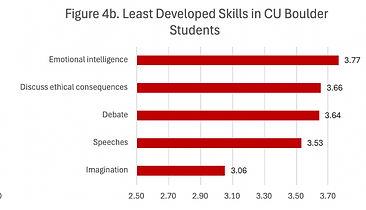
On the contrary, the data highlighted areas where students reported lower skill development. Imagination received the lowest average rating (3.06), significantly below other skills as demonstrated in Figure 4b. Public speaking abilities, represented by speeches (3.53) and debate (3.64), showed room for improvement. Students also indicated lower confidence in discussing ethical consequences (3.66) and emotional intelligence (3.77). While these lower-ranked skills still achieved scores above the median of the scale (3.0), the notable gap between the highest and lowest scores—ranging from 4.18 to 3.06 as demonstrated in Figures 4a and 4b—suggests potential areas for curriculum enhancement. However, the analysis also revealed areas where skill development was less robust, particularly in creative and interpersonal domains such as imagination (3.06/5.0), speeches (3.53/5.0), and debate skills (3.64/5.0).
These findings collectively indicate that while CU Boulder successfully develops core professional competencies in their students, there are opportunities to strengthen creative problem-solving and interpersonal skill development, particularly within science-focused programs as illustrated in Figure 3. The significant variations between academic programs suggest that major choice substantially influences students' perceived preparation and confidence levels across all measured dimensions.
Discussion, Limitations, and Recommendations
This study aimed to understand how undergraduate students perceive and develop critical thinking, problem-solving, and teamwork skills and how universities can better prepare students for professional development and employability. From prior research as well as our own study, it is clear that academic engagement, soft skills, interpersonal abilities, and professional alignment are key aspects influencing career readiness. The importance of soft skills in higher education cannot be overstated. Studies such as An Ngo (2024) demonstrate that higher education institutions must expand beyond technical knowledge to develop well-rounded, socially competent professionals. Research consistently shows that critical thinking, teamwork, and problem-solving abilities are just as crucial as academic expertise in preparing undergraduates for their future careers. These findings strongly align with Deming et al.'s (2023) research, which emphasized the need to develop general soft skills rather than specific knowledge to bridge the gap between recent graduates and employable candidates.
This analysis revealed significant differences between social science and science majors in their self-reported teamwork and problem-solving capabilities (p = 0.000498). Social science majors consistently reported higher levels of engagement in collaborative activities and stronger problem-solving competencies compared to their science major counterparts. This finding aligns with Riebe et al.'s (2016) research highlighting the complexities of teaching teamwork skills and suggests that certain academic programs may be more effective at integrating collaborative learning opportunities into their curricula. The higher confidence levels among social science majors (professional development: 4.07 vs 3.60; transferable skills: 4.08 vs 3.82) echo An Ngo's (2024) findings regarding the importance of intentional soft skill development in academic programs.
A notable trend in the data showed a highly significant correlation (p = 0.000) between academic factors (GPA, major, and weekly study hours) and students' career aspirations. Students with higher GPAs and those who dedicated more hours to studying were more likely to feel aligned with career paths related to their academic disciplines. This finding strongly supports Crawford and Fink's (2020) research on the importance of academic engagement in career preparation, while also reinforcing Deming et al.'s (2023) observations about the relationship between academic investment and professional development. However, academic success alone does not tell the complete story of career readiness. The study identified that students in science majors, despite their academic achievements, often lack the soft skills necessary for professional success. While social science students reported higher levels of teamwork and problem-solving skills, science students expressed lower confidence in these areas, suggesting that traditional measures of academic success must be complemented by intentional development of professional competencies.These findings are reflected through An Ngo's (2024) research, which found that most university students rated their soft skills as merely average despite their academic achievements, highlighting a significant gap between classroom success and professional readiness across disciplines.
The findings also highlighted a discrepancy in specific skills. Students felt confident in their abilities to evaluate sources, communicate effectively, and demonstrate professionalism. However, creative problem-solving, ethical reasoning, and public speaking were rated significantly lower. These gaps suggest that while universities are fostering analytical and interpersonal competencies, there is room for improvement in developing creativity and ethical decision-making skills which is increasingly valued in today's modern workforce. These findings parallel Magallanes' (2022) research, which found that while students were highly engaged in cognitive and behavioral dimensions of learning, this engagement did not always translate into development of specific professional competencies.
A majority of students (69%) expressed positive perceptions about their university's preparation for future employment, yet the presence of a significant neutral and dissatisfied population reveals opportunities for improvement in academic-to-career preparation. This finding becomes particularly notable when examining the distinct differences between academic disciplines. Social science majors consistently reported higher levels of soft skill development compared to science majors, highlighting the need for more intentional integration of collaborative learning opportunities across all disciplines. Ritter et al. (2018) support this observation, suggesting that restructuring courses to incorporate soft skill development could help bridge these departmental gaps. While students generally demonstrate strong capabilities in traditional academic competencies, their lower scores in creative and interpersonal skills indicate that a more balanced approach to skill development is needed. This aligns with Topsakal et al.'s (2022) research, which demonstrates that problem-based learning activities effectively develop both cognitive and social engagement - a model that could be particularly beneficial for programs currently showing lower soft skill development outcomes.
While nearly 69% of students expressed confidence in their university's career preparation efforts, the data reveals that merely having access to development opportunities is not enough - students must actively engage with these resources to maximize their professional growth. Students in science-focused majors particularly need to take proactive steps to develop their teamwork and soft skills, given the significant gap identified between social science and science majors' competencies (p = 0.000498). While social science programs may naturally incorporate more collaborative work, science students should actively seek out additional opportunities for team-based learning beyond their required coursework. This aligns with Riebe et al.'s (2016) research on the importance of teamwork pedagogy and addresses the concerning disparity in professional development ratings (4.07 for social science majors versus 3.60 for science majors).
Given the findings that imagination (3.06), public speaking (3.53), and debate skills (3.64) were among the lowest-rated competencies across all majors, students should prioritize developing these specific areas. The research by Zembylas (2024) on the emotional aspects of critical thinking suggests that students should seek opportunities that push them outside their comfort zones. This could include joining debate clubs, participating in research presentations, or volunteering for project presentations, particularly since employers highly value these communication skills according to Portway (2023).
There were a couple major limitations throughout this study. First, there was a significant gender imbalance among participants, with 63% females and 37% males completing the survey. This skewed distribution likely stemmed from our research team's composition of three females and one male, as team members may have primarily distributed the survey through their personal networks. Second, we encountered incomplete responses, particularly for open-ended questions. For example, six participants did not specify their major/minor, and similar patterns of missing data appeared throughout other sections of the survey. Because of these limitations, the reliability and validity of our data may have been compromised.
Conclusion
This research investigated how undergraduate students develop and perceive critical thinking, problem-solving, and teamwork skills through their university experience, with particular focus on workforce readiness. Together, these skills enable graduates to address the multifaceted challenges they will encounter throughout their careers. The findings revealed that social science majors consistently demonstrated higher levels of perceived career preparedness and soft skill development compared to science majors, particularly in professional development (4.07 vs 3.60) and transferable skills. While students showed strong proficiency in evaluating source credibility (4.18/5.0) and professionalism (4.12/5.0), there were notable gaps in creative and interpersonal skills such as imagination (3.06/5.0) and public speaking (3.53/5.0). Understanding how these competencies are developed during college education provides valuable insight into workforce readiness and the role universities play in preparing students for professional success. As universities continue to recognize the importance of both collaborative abilities and individual problem-solving skills, their role in preparing students for the complex demands of their future professions remains vital to graduate success. However, while universities can provide these developmental opportunities, it ultimately falls to students to actively engage with these resources and take advantage of the various methods available to build these essential workplace competencies.
(Full References & Appendix in PDF Above)