Ella Landry
Communication &
Media Studies Professional
Writing Sample 2
Pretty Little Liars is Poisoning Teens
The entertainment industry glamorizes toxic relationships and that needs to stop
Whether it's a CW drama such as Riverdale or an HBO medieval fantasy epic such as Game of Thrones, the entertainment industry loves to glamorize inappropriate relationship dynamics. While these relationships contribute to the shows' excitement and appeal, they also serve as poor examples of societal norms and acceptable behavior. The 2010 hit show Pretty Little Liars is no exception to the trend of exploiting inappropriate relationships, especially the one between English teacher Ezra Fitz (Ian Harding) and student Aria Montgomery (Lucy Hale).
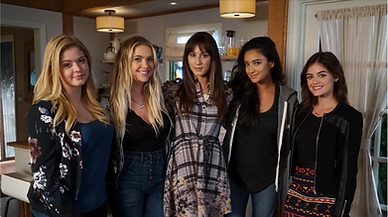
Pretty Little Liars draws its audience in from the first few seconds of the pilot episode. Everything from the quaint and familiar town of Rosewood, Pennsylvania, to the fashion of the 2010s made the show so popular. Young girls like myself were initially entranced by the show's charm, drawn in by the mystery, romantic plotlines, and dramatic twists. One of the main characters was Spencer Hastings (Troian Bellisario). I always tried to replicate her preppy, sophisticated style when getting dressed for school in the mornings.
When watching at such a young age, I was introduced to aspects of adulthood and life I had yet to experience, including sex and relationship dynamics. The show's narratives and relatability allowed a glimpse at interpersonal aspects of relationships and how those might show up in adulthood. The show had the girls going through realistic elements of high school, such as college applications and SAT testing. As a young girl still in the fifth grade, I found it easy to connect and resonate with the girls as the show foreshadowed similar encounters with these experiences and what that could look like.
Although Pretty Little Liars is a good watch, it has some areas that could be improved. The show often showcases multiple relationship dynamics that many viewers probably thought were inappropriate. One particular relationship is that of Aria Montgomery and Ezra Fitz.
To begin, I’d like to discuss what made Aria and Ezra’s relationship so appealing to viewers, myself included, despite its apparent problems. Many viewers thought Aria and Ezra’s relationship was romantic and were even rooting for them for most of the seven seasons. The forbidden love story trope was intriguing and created an idea of star-crossed lovers who are kept apart by circumstances. It’s rebellious, which makes it attractive to young viewers. Not only that but the creator and director of the show, I. Marlene King, romanticized their relationship anytime they were on screen together, making viewers think it was acceptable. How could you not like Ezria (Ezra + Aria)?
Despite all of that, this relationship should not be condoned. Not only does Ezra have a dual role as Aria's teacher and romantic partner, but he is also significantly older than Aria. Both roles play into the significant power imbalance within the relationship and create an uneven dynamic. Ezra was likely 18 when starting college, so with a 4-year degree and a 1-year master's in teaching, he was 23 when he got his first teaching job as an English teacher. In contrast, Aria was only 15 as a sophomore when their relationship began, making Ezra about eight years older than her.
If things could not get any worse, wait, it does. Given Ezra's knowledge of Aria and her friends before their initial encounter, it's clear that his actions could be seen as predatory, manipulative, and deceitful. Fans of the show, like myself, were shocked when Aria forgives Ezra for lying and hiding his past relationship with her friend Alison from her. And (SPOILER ALERT) she even ends up marrying him in the season finale. What kind of message is this sending to young girls who admire these characters?
Obviously, Ezra and Aria are not the only couple on the show. Couples such as Alison (Sasha Pieterse), Ian (Ryan Merriman), and even Hannah and Caleb exemplify how the entertainment industry loves to have a good story. Even though Hannah and Caleb’s relationship makes for a good story, their toxic behaviors outweigh the good moments they have with each other.
Throughout the show, it can be seen that both Hannah (Ashley Benson) and Caleb (Tyler Blackburn) struggle to trust one another. Whether this be because of past relationships or secrets, it creates a sense of tension within their relationship. They both also struggle to communicate with each other. Sometimes, Hannah would not tell Caleb important information, leading to misunderstandings between the two. There were multiple times when Caleb also stormed out of Hannah’s house upset. They clearly love each other deeply, but despite that, Caleb and Hannah can be seen falling into a cycle of toxic behaviors and dysfunction throughout the show.
The relationship between Alison and Ian is exploitative and manipulative. They initially met through Alison’s older brother, Jason, who was friends with Ian. Ian was involved in the same social circles as Alison and her friends, so they ran into each other frequently at parties or school functions in Rosewood. Ian lied to her about his age and intentions when they first met. He told her that he was younger and genuinely interested in her. Their relationship was toxic because of the huge power imbalance, with Ian being older than Alison. Ian can also be seen as a predator, much like Ezra. He was aware of how young Alison was, and he still continued to pursue her.
The show does have a realistic aspect to it in which there are, unfortunately, many toxic relationships among young people who are still unaware of what boundaries look like and what love is. It's not just Pretty Little Liars that depicts these toxic relationships. Many shows write characters like Ezra and Aria, normalizing their behavior and portrayals. Characters like Meredith and Derrick from Grey's Anatomy and Bella and Edward from the vampire film franchise Twilight are prime examples of how the entertainment industry glorifies inappropriate and toxic relationships among young people.
In Twilight, Edward had a lot of control over Bella and her emotions. In the second installment of the franchise, Edward makes the decision to leave Forks because he thinks that he is a threat to Bella's safety. Bella then goes into a deep depression for months, and she is seen making impulsive and dangerous choices just to get a short imaginary glimpse of him. Bella's choices center around Edward, and she lacks independence. Although the books and movies make it seem like Edward and Bella were meant to be, it is quite the opposite. Edward and Bella seem to have unhealthy tendencies within their relationship; it's not romantic, it's rather creepy. What about these relationships are so appealing to studios and writers?
Although these types of relationship dynamics may be captivating and a little thrilling to watch, they create a skewed perception of genuine connections in young audiences. Recent articles have revealed concerning trends among Gen Z, indicating a normalization of toxic relationships. Being a part of Gen Z, I have seen firsthand how the relationships we see on TV reflect how my generation views love in real life. For the longest time, I thought that relationships were supposed to feel exciting and passionate every second of every day for it to be considered worthwhile, and they should be to an extent. But the truth is that relationships need to be maintained. They take communication and understanding from both sides, and there will be ups and downs. Over the years, I’ve learned that comparing my real-life relationships to those portrayed on screen is not good. Obviously, relationships should have excitement, but viewing them as needing a constant source of euphoria sets people up for dissatisfaction in their dating life.
Pretty Little Liars promotes inappropriate and unhealthy relationships to easily influenced young viewers by glamorizing manipulation, dishonesty, and controlling behaviors. Young girls like myself looked up to characters like Spencer, Hannah, and Aria, which is why it is so important to portray healthy dating for the next generation. Think about this, would you want your son or daughter to date someone like Ezra? Or, even worse, be someone like Ezra? If the answer is no, as it should be, it’s clear that we need to be more conscientious of the stories around relationships that we expose young adults to.